
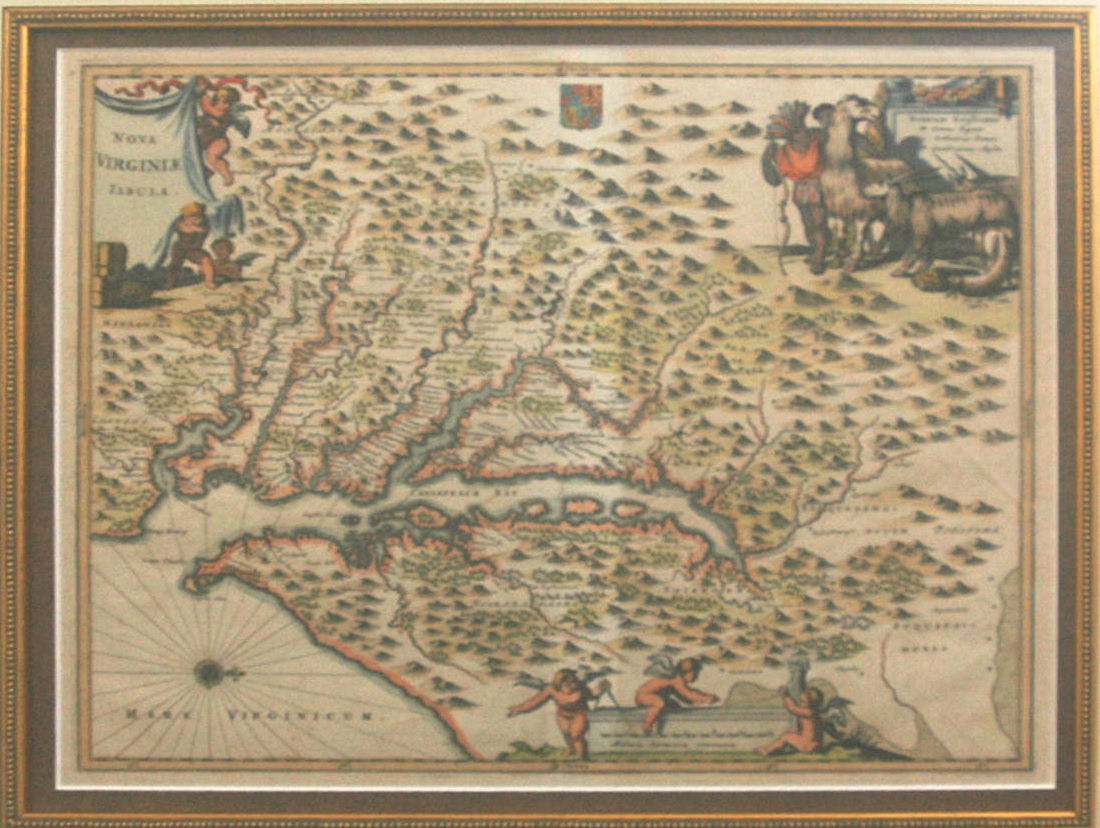
On the upper right corner of his 1671 map of Virginia, Nova Virginiae Tabula, the engraver Jacob van Meurs included a map legend for three elements depicted only as symbols on his map. That’s not unusual, you say. Well, what is unusual is the image that surrounds the legend: an Indian, an African American, a longhorn sheep and its lamb, a unicorn, and a llama, all presumably native to Virginia. We can easily dismiss the unicorn, but not the llama.

Detail from Nova Virginiae Tabula.
Nova Virginiae Tabula.
The ancestors of llamas (called New World Camelids), and perhaps llamas themselves, once thrived in North America; in fact Camelids originated in the Central Plains of North America about 10 million years ago. Camelids migrated to Asia and are thought to be the ancestors of the African and Asian camels. Camelids also migrated to South America where they became the llama, vicuna, alpaca and guanaco; the latter three resembling the llama. Llamas were not always confined to South America; llama-like remains have been found in deposits in the Rocky Mountains. But, were there llamas in North America when the first European explorers arrived and took back information about the topography, flora and fauna? No! All camelids had been extinct in North America for thousands of years, perhaps as the result of the last ice age. It was not until the late 1800s that llamas were slowly re-introduced into North America. And it was not until the post World War II years that there was any real interest in raising llamas as pets and pack animals and for the economic benefit of their very soft, lanolin-free wool.
One can only speculate as to the reason the llama appears on a 347 year-old map of Virginia. Perhaps van Meurs simply assumed that the animals seen in South America also lived in North America.
What reasons have you heard for this seemingly unfounded use of an image of the llama?
Tales from the Rare Map Cabinet by Luke A Vavra
Stock Number N5013
MAP SOLD
Leave a Reply